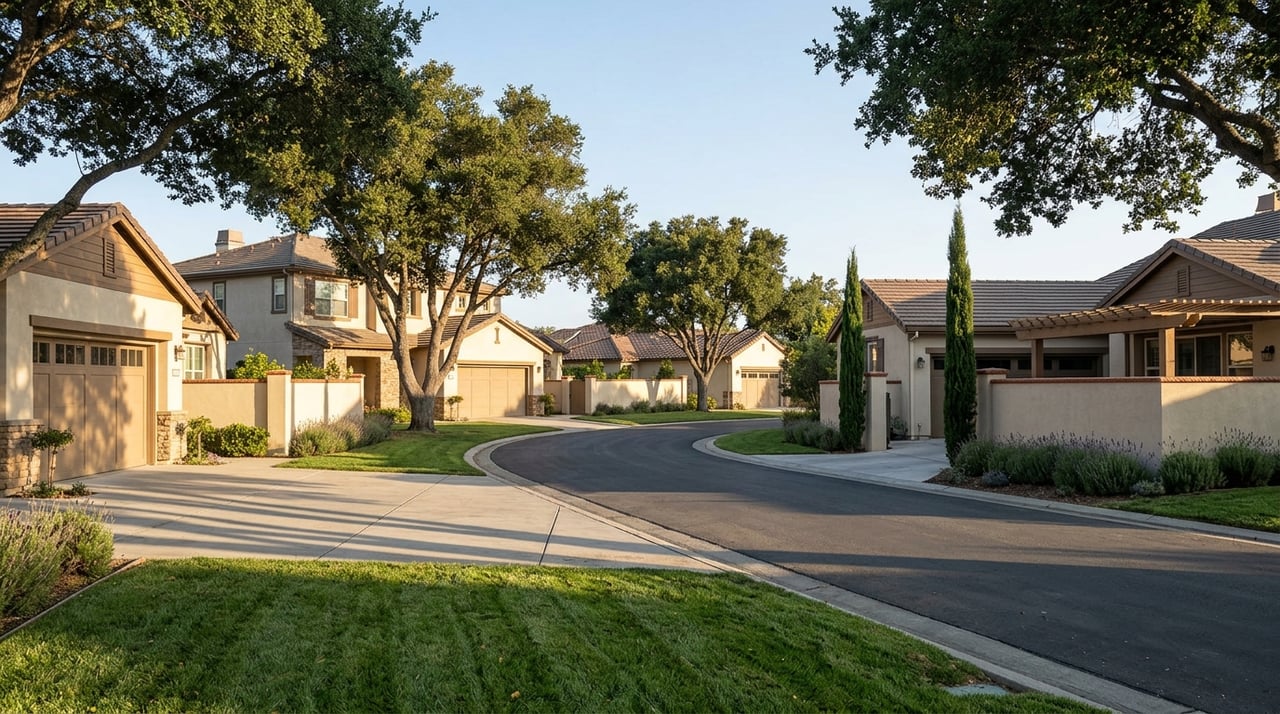
If you asked five different agents this month what a home in Sommers Bend is worth, you would get five defensible answers, and none of them would agree. Pull the active listings inside that community boundary right now and you will find a three-bedroom townhome near $525,000 within walking distance of a three-bedroom, four-bath single-family home listed at $2,000,000. Same masterplan. Same clubhouse system. Same stretch of Roripaugh Valley Road running past it. A four-times spread in price, sitting under one community name.
That spread is not a market glitch. It is how Sommers Bend was built. This is not one neighborhood with one builder aiming at one kind of buyer. It is a collection of separate product lines, stitched together under a shared marketing name, each with its own construction schedule, price ladder, and household it is trying to attract. If you are pricing a resale home nearby, or shopping new construction and wondering why one flyer says $800,000 and another says $1.6 million for what looks like the same zip code, this is the reason. And it changes how you should be pulling comps.
Six Names Under One Sign
Inside the boundary most people just call "Sommers Bend," there are at least six distinct product lines, each aimed at a different buyer:
- Crestview, built by Richmond American Homes, planned for 104 single and two-story homes with configurations up to six bedrooms.
- Goldenview Estates, a smaller Richmond American phase of 13 homes.
- Sablewood Estates, another Richmond American phase, 15 homes.
- Discovery, a 177-unit townhome collection built by Woodside Homes, aimed at buyers who want the community's amenities without a single-family lot.
- The SHAWOOD collection, a separate, design-forward product line marketed directly under the SHAWOOD name, with open-concept great rooms and larger floor plans priced at the top of the community's range.
- Esplanade, the community's age-restricted section for buyers 55 and older.
Each of these has its own construction timeline, its own incentive cadence, and its own buyer pool. A young family shopping Crestview for a six-bedroom production home is not competing with a retiree looking at Esplanade, and neither of them is pricing against someone touring the SHAWOOD model. Yet all three show up if you search "Sommers Bend" on any portal. Treating that search result as a single comp set is where sellers and buyers both start making decisions off the wrong number.
What the March Grand Opening Actually Signaled
In March 2026, Richmond American held a grand opening event for 132 new homes across the Crestview, Goldenview Estates, and Sablewood Estates phases, complete with a Mediterranean cookout, a live DJ, and an ice cream bar. The homes ranged from single to two-story layouts with up to six bedrooms, starting at $800,000, with the first homes ready for move-in that April.
Set aside the balloon artist for a second. What that event actually did was drop a wave of six-bedroom, entry-priced inventory into the market at the exact moment resale sellers of larger single-story homes nearby were trying to attract the same family buyers. For someone listing a comparable four or five bedroom resale home in the surrounding tract this spring, the real competition was not an algorithm's neighborhood radius. It was that specific weekend, that specific price floor, and whatever financing came attached to it.
This is the piece that gets missed when people price off a general area search instead of the actual phase competing for the buyer. An $800,000 starting price on a brand new six-bedroom home resets the conversation for every resale listing within a few streets of it, whether or not the resale home is technically "in" Sommers Bend.
The Rate on the Flyer Isn't the Rate You're Competing Against
Here is the part that actually decides who wins the buyer. Builders in 2026 are not cutting sticker prices to move inventory. They are buying down the buyer's monthly payment instead, because that keeps the community's on-paper values intact while still making the deal work. The most common version is a 2-1 buydown, where the buyer's rate is reduced by two percentage points in year one and one point in year two before settling at the full note rate. Some builders offer a permanent rate reduction instead, paid for with discount points at closing.
Richmond American's own 2026 promotional filings for its Inland Empire communities show exactly this kind of financing in action, with example FHA rates as low as 3.750% against a base example sales price, funded through the builder's in-house lender. That is a materially lower monthly payment than a buyer would get on the open market this year, and it is baked into the deal before the buyer ever negotiates on price.
Here is why that matters if you are selling nearby. Temecula's citywide median sale price sat at $775,000 as of May 2026, with homes moving in a median of 48 days and just 1.16 months of supply on the market. On paper, a resale home priced near that median looks competitive against a new build listed similarly. But if the new build comes with a builder-funded rate buydown and the resale home does not, the buyer's actual monthly cost on the new construction option can be meaningfully lower, even though the two homes show the same number on a listing sheet.
A home's list price is not what a buyer pays. It is the number before the incentive gets applied.
A Framework for Pricing Near a Big Masterplan
Whether you are listing a resale home near Sommers Bend or shopping there yourself, the fix is the same. Stop comping the community name and start comping the specific phase and the specific deal.
- Identify the actual comparable phase, not the community name. A four-bedroom single-story resale home should be measured against Crestview or a similar production phase, not against the SHAWOOD collection or Esplanade.
- Call the builder sales office for the current incentive sheet. Incentive packages shift monthly and sometimes weekly around events like the March grand opening, so an offer that was live in spring is not guaranteed to still be running by fall.
- Translate any incentive into two numbers: monthly payment and cash to close. A rate buydown, a design credit, and a closing cost credit solve different problems for a buyer, and the headline dollar value on the flyer rarely tells you which one actually helps them.
- If you are selling resale, consider offering a comparable mechanism rather than a flat price cut. A seller-funded rate buydown addresses the same monthly-payment math a buyer is seeing on the builder's side, without giving up as much on the sale price itself.
- Use the citywide pace as your timing gauge, not your pricing gauge. With 1.16 months of supply and 48-day median market time as of May 2026, this is not a market where either side has unlimited time to wait out the other, but it is also not so tight that a well-priced resale home should feel pressured to undercut new construction on sticker price alone.
A Few Direct Questions
Does the price spread inside Sommers Bend mean the community is losing value? No. The spread is structural, not a signal of decline. It reflects six different product lines built by different builders at different price points, all sharing one marketing name. The citywide market these homes sit inside was still moving at a median of $775,000 with 48-day market times as of May 2026.
Can a resale seller realistically match a builder's incentive dollar for dollar? Usually not, and trying to is the wrong goal. What works better is addressing the same math the buyer is weighing, most often through a seller-funded rate buydown at closing rather than a price reduction that doesn't move the buyer's monthly payment nearly as much.
How long do these builder incentive packages stay active? They change often, sometimes tied to a specific event like a grand opening weekend, sometimes tied to a builder's fiscal quarter close. An incentive that was live back in March is not something you can assume is still on the table months later, which is why calling the sales office directly matters more than trusting a flyer you saw earlier in the year.
If you are trying to price a home near a masterplan like this, or you are cross-shopping new construction against resale and want the real numbers instead of the flyer numbers, Erin Archibek Mills can walk through the specific phase, the specific incentive, and what it actually means for your bottom line. Let's connect before you price off the wrong comp.